Trimara Reviews: My Honest Experience After Using This GLP-1 Supplement for 90 Days
I’ll be straight with you — I was skeptical.
I had tried enough supplements to know that most of them overpromise and underdeliver. But after 90 days of using Trimara, I have enough to say that this one genuinely surprised me. Not in a dramatic, overnight-transformation kind of way. In a quieter, more sustainable way that actually stuck.
Here’s my full, unfiltered experience.
Contents
- 1 Why I Decided to Try Trimara
- 2 What Is Trimara GLP-1 Supplement? (Quick Overview)
- 3 My First Week Using Trimara (Days 1–7)
- 4 What Happened After 4 Weeks
- 5 My 90-Day Results (Honest Review)
- 6 What I Liked About Trimara
- 7 What I Didn’t Like
- 8 Who I Think Trimara Is Best For
- 9 Is Trimara Worth It? My Final Opinion
- 10 Frequently Asked Questions
Why I Decided to Try Trimara

Click here to claim a discounted Trimara from the official website (if it’s still available) >>
For most of my adult life, I’ve had a complicated relationship with food. Not in a dramatic way — I wasn’t binge eating or skipping meals. It was subtler than that. I just couldn’t stop thinking about food.
By mid-afternoon, I was already mentally planning my next meal. After dinner, I’d find myself in the kitchen looking for something sweet even when I wasn’t genuinely hungry. Cravings ran the show, and I always felt like I was fighting my own body.
I also noticed that my metabolism felt slower than it used to. Clothes that fit fine two years ago were suddenly snug. My energy would crash after lunch. I wasn’t making dramatically different choices — my body just seemed to be responding differently than it once had.
I looked into GLP-1 medications after seeing them everywhere in health news. The science made sense to me — GLP-1 is a gut hormone that signals fullness to the brain, and when it functions well, appetite regulation becomes more natural. But injections felt extreme for what I was dealing with. I didn’t have a medical condition requiring prescription intervention. I just wanted my appetite back under control.
That’s when I came across Trimara. It was positioned as a natural way to support GLP-1 production through gut health — no injections, no prescription, no synthetic hormones. The concept made biological sense to me, so I decided to give it a legitimate 90-day trial.
What Is Trimara GLP-1 Supplement? (Quick Overview)
Before I get into my experience, here’s a simple explanation of what Trimara actually is.
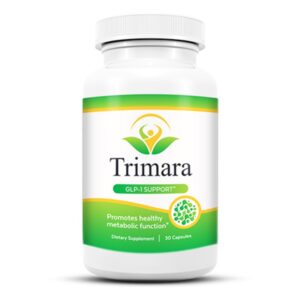
Trimara is a natural dietary supplement designed to support your body’s own GLP-1 production. GLP-1 is a hormone made in your gut that tells your brain when you’re full. When this system works properly, appetite feels manageable. When it doesn’t, hunger feels constant and cravings feel overwhelming.
Rather than replacing GLP-1 with a synthetic version (like injectable medications do), Trimara works by improving the gut environment so your body can produce more GLP-1 naturally. It does this through a combination of prebiotic fiber and targeted probiotic strains — ingredients that feed and strengthen the beneficial bacteria in your gut.
The formula comes in a simple capsule. One per day, taken before your biggest meal. That’s it.
No mixing powders, no complicated schedules, no needles. Just one small capsule as part of your daily routine.
Click here to claim a discounted Trimara from the official website (if it’s still available) >>
My First Week Using Trimara (Days 1–7)
I started taking the Trimara GLP-1 supplement on a Monday morning. I took it about 20 minutes before lunch, as recommended, and honestly didn’t notice much that first day. I wasn’t expecting fireworks, but I want to be transparent — week one was mostly about my digestive system adjusting.
By day three, something interesting happened. My digestion felt noticeably smoother. I’d dealt with mild bloating after meals for years — something I had just accepted as normal — and it was visibly reduced. I felt less heavy after eating.
My energy in the first week felt fairly steady, though I wasn’t sure if that was the supplement or just the placebo effect of doing something intentional for my health. I didn’t notice dramatic appetite changes in week one, which was completely in line with what I had read. Gut changes take time.
By day seven, I had better digestion, less post-meal bloating, and a slightly lighter feeling overall. Not life-changing yet — but a promising start.
What Happened After 4 Weeks
Weeks two through four were where things started to get genuinely interesting.
The most noticeable shift was in my cravings. That relentless afternoon snack urge — the one that usually had me hunting for something sweet around 3 PM — started to quiet down. It didn’t disappear entirely, but it lost its urgency. Instead of feeling compelled to eat, I could acknowledge the thought and move past it without a battle.
Portion control improved without me forcing it. I’d sit down to dinner and find myself stopping naturally before finishing my plate. Not because I was being disciplined — it just felt like enough. That was new for me.
I also noticed that I was eating more slowly. I don’t know if that’s directly tied to the supplement or whether better gut-brain signaling was making me more tuned in to how full I actually was. Either way, I was eating less without feeling deprived.
At the four-week mark, I had lost a few pounds. Nothing dramatic — and I want to be honest about that. I hadn’t overhauled my diet or started a new exercise regime. The change was subtle but real, and more importantly, it felt effortless compared to previous attempts.
My 90-Day Results (Honest Review)
By the time I hit 90 days, I had a clear picture of what Trimara had and hadn’t done for me.
Appetite stability was the biggest win. The constant background noise of food cravings had significantly settled. I no longer felt like appetite was something I had to wrestle with every day. My hunger became more predictable — I’d feel genuinely hungry at meal times and genuinely satisfied afterward. That rhythm made everything else easier.
Energy levels improved meaningfully around the six-week mark and stayed consistent through the rest of the 90 days. I stopped experiencing the post-lunch slump that used to derail my afternoons. I attribute this largely to more stable blood sugar — less spiking and crashing from eating smaller, more appropriate portions.
My eating habits shifted in a way that felt organic rather than forced. I naturally gravitated toward lighter meals because heavy ones simply didn’t appeal to me the way they once had. I was still enjoying food — just in a more balanced relationship with it.
Overall confidence in managing my weight improved substantially. Not because the number on the scale had transformed dramatically, but because for the first time in years I felt like I was working with my body instead of against it. That psychological shift is hard to overstate.
Long-term sustainability is what I’m most impressed by. Previous attempts at appetite management involved willpower — which always runs out. This felt different. When hunger signals are more balanced, good choices don’t require as much effort.
Don’t miss out — click here to claim your discounted Trimara (if it’s still available) >>
What I Liked About Trimara
The formula is natural. There are no stimulants, no synthetic hormones, nothing that makes your heart race or your hands shake. It works with your biology, not against it.
One capsule a day is genuinely easy. I’ve abandoned supplements before simply because the regimen was complicated. With Trimara, there’s no reason to skip — it takes five seconds.
No injections. This was a dealbreaker for me from the start. The fact that Trimara supports GLP-1 production naturally meant I could pursue the metabolic benefits of this hormone without medical appointments, prescriptions, or needles.
Gut health improvement was a real bonus. I didn’t sign up for Trimara primarily as a digestive supplement, but the reduction in bloating and the improvement in regularity were noticeable and welcome side effects of the gut-focused formula.
What I Didn’t Like
I want to be fair here, because no product is perfect.
Results are not instant. If you’re looking for something that works in a week, Trimara is not that. The first few weeks are primarily about gut adjustment, and appetite changes don’t really kick in until around the four-week mark for most people. Patience is required.
Consistency is non-negotiable. I missed a few days around week five due to travel, and I noticed a slight return of afternoon cravings. It wasn’t dramatic, but it was a reminder that this supplement works cumulatively — it’s not something you can take on and off and expect the same results.
Mild digestive adjustment in the early days. During the first few days, I had slightly more gas than usual. It wasn’t uncomfortable or alarming — it’s a normal response to introducing new prebiotic fiber and probiotic strains — but it’s worth knowing about going in.
Who I Think Trimara Is Best For
Based on my experience, I think Trimara is genuinely well-suited for:
People who struggle with cravings. If you’re not physically hungry but still find yourself constantly thinking about food, grazing throughout the day, or losing willpower battles with snacks — this addresses the root cause rather than just the symptom.
Those who want natural GLP-1 support. If you’ve read about GLP-1 and its role in appetite regulation but aren’t a candidate for or interested in prescription medication, Trimara offers a gut-centered alternative.
Adults looking for metabolic balance. If your metabolism feels sluggish, your energy is inconsistent, or you’ve noticed weight creeping up despite no major lifestyle changes, addressing gut health and natural hormone signaling is a logical first step.
People who don’t want prescription injections. Whether it’s the medical requirement, the cost, the side effects, or simply a preference for natural approaches — Trimara fills that gap.
Check to see if Trimara GLP-1 supplement is still available>>>
Is Trimara Worth It? My Final Opinion
Would I buy it again? Yes — and I already have. I’m currently into my second 90 days.
Did it meet my expectations? It exceeded them in some ways and met them honestly in others. I didn’t lose 30 pounds in three months. But I also wasn’t expecting to. What I was hoping for was a more peaceful relationship with appetite, more consistent energy, and a gut that felt better. All three happened.
Who should consider it? Anyone willing to commit to at least 60–90 days of consistent use while also putting in reasonable effort with their diet and lifestyle. Trimara is a support tool, not a substitute for healthy habits. When you combine the two, the results feel genuinely sustainable.
Who probably shouldn’t bother? Anyone expecting dramatic rapid weight loss without making any other changes. That’s not what this product is designed to do, and expecting it to work that way will lead to disappointment.
My honest verdict: Trimara is a well-formulated, gut-focused supplement that does what it says it will — gradually, sustainably, and without side effects that make life harder. In a supplement market full of exaggerated claims, that’s more impressive than it sounds.
Frequently Asked Questions
How long did Trimara take to work for me?
I noticed digestive improvements within the first week. Appetite and craving changes became noticeable around the four-week mark. By 90 days, I had a clear picture of the full range of benefits. Based on my experience, I’d say give it a minimum of 60 days before drawing conclusions.
Did I experience any side effects?
The only thing I noticed was mild bloating and slightly increased gas during the first three to four days. This settled completely by the end of week one and is a normal response to new prebiotic fiber. After that initial adjustment, I experienced no negative effects whatsoever.
Would I recommend Trimara?
Yes — with the caveat that you go in with realistic expectations and commit to consistent daily use. If you’re looking for a natural approach to appetite control and metabolic support and you’re willing to give it time, I think most people will find it worthwhile.
Where did I buy Trimara?
I purchased directly through the official Trimara website. I’d recommend doing the same to ensure you’re getting the authentic product and to take advantage of the multi-bottle discount packages. The 3- or 6-bottle options offer meaningfully better value per bottle and align with the time frame you’ll need to see the best results.

Disclaimer: This article reflects a personal experience and is intended for informational purposes only. Trimara is a dietary supplement, not a medication. Individual results will vary. Always consult a healthcare professional before starting any new supplement, particularly if you have a medical condition or take prescription medications.